So here's the question. You've got one AI agent writing your code. You're not just vibe coding. You're letting that agent write the full code, in Rust, Python or whatever language you chose. (Yes, at this point we're still writing languages, but more on that in a later post.) Should the SAME AI agent approve it?
Picture a founder running a team of 15 or 16 people. About six are developers: three senior, two mid level and one entry level. Do they have one agent writing the code and another reviewing it? Sonar found that 57% of developers using AI agents use them to review code. But we found no published figure on how often the reviewing agent is a different one from the agent that wrote the code.
Well, here's the deal. The National Credit Union Administration's examiner guide says every wire system should require at least two separate participants: one person who inputs or requests the transfer, and another who verifies and sends it.
We tried that rule on software built by AI.
An Anthropic model built. An OpenAI model tried to break it. A human decided what happened next.
This is early learning, not proof. No users have been enrolled, so the software's stability and quality are unproven.
What we saw
We reviewed one prelaunch build from October 28 to November 4, 2026. The verifier did not grade clarity or style. It ran the software through its own test scenarios and checked what actually happened: who could see what, whether deleted data stayed deleted, whether a retry repeated an action, and whether money amounts were handled correctly. It responded 65 times:
- 32 rejected: at least one high or medium severity problem was still open, so the work had to be fixed and tested again.
- 15 accepted: every scenario in that round passed, including reruns of earlier ones, at local scope.
- 18 advisory or partial: advisory means it reviewed a plan or design without a pass or fail. Partial means it passed only within a limited scope, or with smaller issues still open.
One feature was rejected 9 times before it passed. Another was rejected 7 times. Testing was local, and some of it used mocked providers.
The verifier found problems a demo would not show. Deleted records could come back. A timing bug could remove a saved file. Files could stay in storage after deletion, untracked.

4 rejections at the grand scale
4 rejections a day may not sound like much. But inside an enterprise, just one problem getting through could mean leaked card data or a leaked login. That is millions of dollars, possibly billions. It lands like a punch from Mike Tyson. Your company could be toast or untrustworthy.
- Leaked card data: In 2013, hackers stole data from up to 40 million credit and debit cards at Target, getting in with credentials stolen from an outside vendor. Target reported $202 million in costs.
- Leaked login: In 2024, attackers used a compromised login on a Change Healthcare portal that had no multifactor authentication. Its parent company, UnitedHealth, spent $3.1 billion responding that year.
Neither case was about AI writing code. The point is what one miss can cost. Ours was a prelaunch build, tested locally inside a test harness, with synthetic data and guardrails in place.
Why this matters now
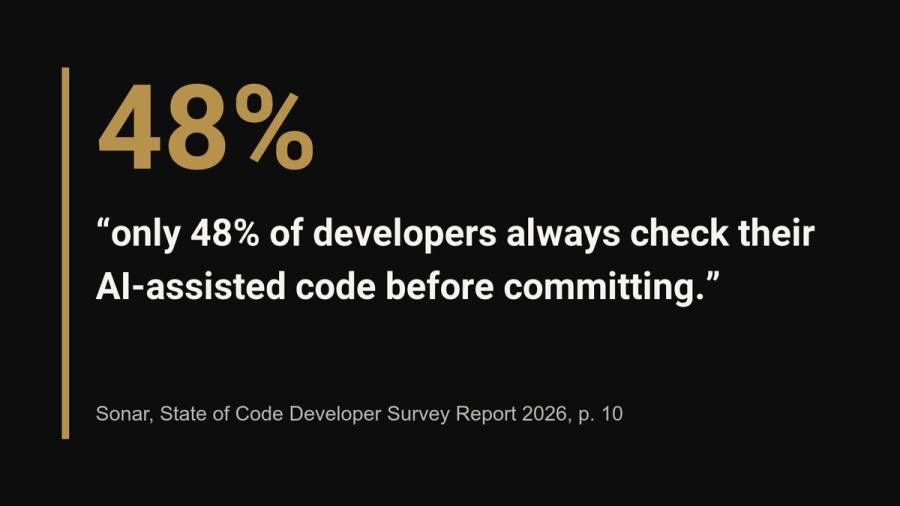
In Sonar's 2026 developer survey, respondents reported that 42% of their committed code is generated or assisted by AI. Only 48% said they always check it before committing. Veracode found that about 4 in 10 AI coding tasks produced vulnerable code without security guidance. Both companies sell code security products, so weigh their numbers with that in mind.
Where we would test it next
We have not run this method in these industries. These are the failures we would try to force first:
- Fintech: one investor sees another's data, or a reported figure changes without approval.
- Properties: a changed clause gets missed, a superseded draft gets approved, or a variance condition gets dropped.
- M&A: one deal's records land in another deal's file, or a figure changes with no record of who changed it.
- Logistics: a document changes after signoff, or a retry books the same shipment twice.
- Money markets: a retry moves money twice, or the ledger and the bank disagree and nobody is told.
What this doesn't prove
I mean, come on, you all. One build and 8 days cannot possibly show that the method works in production, not even close. We would need more like millions of runs. We also found no published figure for how many companies run AI verification across vendors. (If your company does, please hit us up at [email protected].)
We would use it on:
Access.
Why access? One wrong permission shows one person's private data to someone else.
Deletion.
Why deletion? When deleted data comes back, you have a privacy problem and possibly a legal one.
Money movement.
Why money movement? A repeated or wrong payment costs real money and can be hard to undo.
Approvals.
Why approvals? If an approval can be skipped or changed, nothing after it can be trusted.
...and leave routine screens to normal testing and human review.
If your business runs on any of the workflows above, where would you test it first? Tell us here.
Sources
sonarsource.com Sonar, State of Code Developer Survey Report 2026, p. 5 (n=1,148), p. 10 (n=1,149) and p. 20, surveyed October 2025. sonarsource.com/state-of-code-developer-survey-report.pdf
veracode.com Veracode, AI code security update, October 29, 2026, 18 models. veracode.com/?p=33104
ncua.gov National Credit Union Administration, Examiner's Guide, Electronic Payment Systems. publishedguides.ncua.gov/examiner/Content/ExaminersGuide/ElectronicPaymentSystems/MitigateRisks/People.htm
nbcnews.com NBC News, Target settlement over its 2013 data breach, May 24, 2017. nbcnews.com/business/business-news/target-settles-2013-hacked-customer-data-breach-18-5-million-n764031
healthcaredive.com Healthcare Dive, how attackers got into Change Healthcare, April 30, 2024. healthcaredive.com/news/change-healthcare-compromised-credentials-no-mfa/714824/
healthcaredive.com Healthcare Dive, UnitedHealth's 2024 response cost, January 27, 2025. healthcaredive.com/news/change-healthcare-cyberattack-affects-190-million-unitedhealth/738351/
smg-ops.com Our counts: SMG-Ops verification log, read November 4, 2026.